Intelligent Gate Valve Transformation for Water Conservancy Projects
Abstract: Given the growing severity of global water scarcity and the pervasive aging of water conservancy infrastructure, the industry has increasingly turned to the intelligent retrofitting of gate valves as a pathway to achieving smarter, more efficient water management. This paper synthesizes findings from a comparative analysis of relevant literature and case studies. Drawing on technological advancements in the Internet of Things, artificial intelligence, and big data, it systematically categorizes and organizes the technical architecture and current application status of gate valves. Research shows that intelligent gate valves, which integrate sensors, adaptive algorithms, and remote monitoring technologies, can improve the management efficiency of water conservancy projects by more than 30% and reduce operation and maintenance costs by 25%, demonstrating strong potential for applications in pipeline management and flood control scheduling.
The rational scheduling of water resources has become a significant challenge amid global climate change and growing population pressures.
Traditional gate valves used in water conservancy projects are still operated manually or mechanically, which can lead to several problems, including:
· Sluggish response
· Suboptimal control accuracy
· High operation and maintenance costs
In recent years, rapid advances in technologies such as artificial intelligence and the Internet of Things have enabled intelligent gate valves to perform more advanced functions, including:
· Real-time flow monitoring
· Automatic pipeline flow regulation
· Early warning of equipment failures
These capabilities can significantly improve the safety and reliability of water pipelines and valve systems. Magnetic water-absorbing control devices, for example, can provide precise flow control while also significantly reducing operation and maintenance costs by approximately 30%.
Intelligent gate valve technology is currently shifting from standalone control toward system integration. Integrated intelligent gate valves equipped with flow measurement sensors, drive units, and other components can provide advanced functions such as:
· Dynamic speed regulation
· Remote control
· Real-time operating status monitoring
These integrated systems are now widely applied in agricultural irrigation and urban water supply systems. Notably, the digital twin–driven intelligent roller compaction construction approach adopted for the Taiping Reservoir project by China Construction Eighth Engineering Bureau has demonstrated intelligent control throughout the entire construction process, providing a valuable reference for the integrated design of intelligent gate valve systems.
This paper aims to:
· Map out the technical development path of intelligent gate valves
· Identify key bottlenecks limiting their practical application
· Provide theoretical and practical guidance for the modernization of water conservancy projects
Through an examination of typical case studies and recent technological developments, this article further demonstrates the far-reaching impact of intelligent transformation on water resource management, disaster risk reduction, and ecological preservation.
Multi-source sensing and data acquisition form the foundation of digitalization in modern water conservancy projects. Intelligent gate valves use a multi-source sensing network to establish a “digital nervous system” for monitoring and control. The system is characterized by:
· Precise point positioning
· Unit-level zero-distance measurement
· Rapid process data analysis
Different sensors perform different monitoring functions. Position sensors continuously track the valve stem displacement trajectory with millimeter-level accuracy, while pressure sensors monitor the dynamic shock-wave spectrum generated when the fluid impacts the valve body. Temperature sensors continuously monitor the thermodynamic operating environment of the valve body.
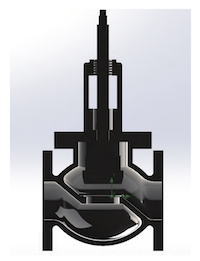
A smart water conservancy demonstration project shows that magnetic coupling devices and hydraulic drive units installed at a sewage pumping station can work together to establish a collaborative sensing matrix. This system can rapidly transmit water-level fluctuation data to the control center, after which the collected information is transmitted to upstream hydraulic structures through the water-level regulation module. This enables rapid water-level adjustment and provides critical support for flood control during the rainy season. The structure of an intelligent gate valve equipped with a displacement sensor is shown in Figure 1.
The multi-source sensing network serves as a fault diagnosis mechanism based on the correlation of data from multiple sources. When a pressure sensor detects an abnormal pipeline pressure reading, the system cross-checks it against data from surrounding nodes, such as vibration spectra and flow-velocity variations, and uses edge computing to determine the nature of the anomaly.
By overlaying and correlating fluid velocity data with vibration spectra, the system compares changes in the valve body’s resonant frequency with corresponding fluctuations in fluid velocity frequency through vibration spectrum analysis. This makes it possible to determine whether an anomaly is caused by mechanical wear or sudden fluid fluctuations, providing early warning and eliminating the need for reactive repairs after a pipe rupture occurs. Table 1 shows the multi-dimensional sensing performance of the intelligent gate valve. The mechanical sensing module analyzes the water-flow impact force spectrum captured by a piezoelectric ceramic array, generating data that supports flood-control operations.

Figure 1 Intelligent gate valve with displacement sensor
Sensing Dimension | Monitoring Indicator | Technical Implementation | Decision Response |
Spatial Sensing | Valve stem displacement | Laser ranging + encoder | Opening control error <0.5% |
Mechanical Sensing | Hydraulic impact force | Piezoelectric ceramic array | Flood control response time reduced by 40% |
Environmental Sensing | Temperature and humidity variations | IoT node networking | Equipment fault warnings issued 2–3 hours in advance |
In the Yangtze River Basin flood control system, a group of intelligent gate valves shares real-time water pressure data from 20 monitoring points both upstream and downstream. The cloud computing center can issue flood diversion decisions in just 8 seconds, a substantial improvement over the time required under manual operation. However, the sheer volume of real-time data places heavy demands on edge computing units. To overcome this bottleneck, some manufacturers have adopted FPGA chips for parallel data processing, leveraging hardware acceleration to significantly increase processing speed and reduce latency by up to 70%.
Control algorithms play a central role in the digital transformation of water conservancy projects. Taking a water diversion project as an example, its gate control system uses a three-stage closed-loop regulation strategy that integrates:
· Feed-forward compensation
· Real-time verification
· Lag correction
This strategy ensures stable flow control even when the flow rate suddenly changes by 3 m³/s, maintaining the flow deviation within 1.8% over an extended period.
The underlying improvement comes from an upgrade to the traditional PID control framework. An external-factor compensation module is integrated into the control loop, allowing the system to automatically adjust the regulation coefficient according to changing operating conditions, such as variations in gate opening caused by temperature changes.
The intelligent gate valve control system also goes beyond basic numerical calculations or threshold-based simulation methods. Its brain-like decision model incorporates multiple environmental and hydraulic variables when radar echo maps detect approaching rain clouds, including river cross-sectional geometry, silt-layer thickness upstream of the gate, incoming rainfall conditions, and other relevant hydraulic parameters. By combining the outputs of the brain-like decision model, the system generates a tiered warning scheme and transmits the corresponding alerts to the intelligent gate valve control system.
The end-to-end response time, from decision-making to on-site valve action, is only 4 minutes and 50 seconds. Compared with traditional fixed-parameter calculation models, this approach significantly shortens the time between decision-making and on-site response, providing critical additional buffer time for downstream communities. Table 2 provides a performance evaluation of multi-variable adaptive control modes under different environmental conditions.
Control Mode | Response Dimension | Typical Error Rate | Applicable Scenarios |
Basic PID Control | Single-parameter closed-loop control | ±3.5% | Regulation under stable operating conditions |
Fuzzy Compensation Control | Environmental-variable coupling | ±2.1% | Sediment-laden or high-turbidity water flow |
Dynamic Predictive Control | Multi-parameter spatiotemporal prediction | ±1.2% | Flood peak passage or rapidly changing flow conditions |
However, the current algorithm architecture has yet to be fully proven in real-world engineering applications. For instance, in a smart irrigation district project in one province, the sensor network experienced a packet loss rate of over 5%. Time-series analysis algorithms experienced decision delays exceeding twice the baseline rate, attributable to insufficient coordination between edge and cloud computing nodes. This requires introducing a lightweight digital twin that runs a virtualized sensing node on-site, effectively serving as a local data anomaly handler.
The Internet of Things (IoT) has driven significant innovation in the operation and maintenance of water conservancy equipment. The Taiping Reservoir project, for example, uses a management platform that combines spatial data with building information. The platform integrates GIS and 3D modeling to break down the data silos commonly found in conventional gate valve management.
By leveraging IoT technology to collect critical data, including:
· Operating parameters
· Environmental conditions
· Stress variations
the system enables remote diagnosis for more than 90% of routine maintenance tasks. This approach not only overcomes the limitations imposed by geographic distance but also significantly expands the effective working radius of equipment management personnel.
The “spatial data + building information” management system is based on a dynamic evaluation algorithm that creates a life-cycle digital twin for each piece of equipment. This enables historical performance data to be compared side by side with real-time operating data, while predictive analytics can identify potential equipment malfunctions up to 72 days in advance, allowing maintenance personnel to take preventive action before failures occur.
The post-implementation results, summarized in Table 3, demonstrate significant improvements in maintenance performance:
· Fault response time decreased to 1.5 hours, representing a 64% improvement.
· The spare parts replacement interval increased from 6 to 9 months, representing a 50% improvement.
· The frequency of unplanned downtime decreased from 18 to 7 incidents per year, a reduction of approximately 61%.
Collectively, these improvements generated RMB 1.27 million in maintenance cost savings, demonstrating the practical value of IoT-enabled remote operation and predictive maintenance for intelligent gate valve systems.
Indicator | Traditional Maintenance Mode | Predictive Maintenance Mode | Improvement |
Fault Response Time | 4.2 hours | 1.5 hours | 64% reduction |
Spare Parts Replacement Cycle | 6 months | 9 months | 50% increase |
Unplanned Downtime Events | 18 times/year | 7 times/year | 61% reduction |
Drawing on lessons from actual engineering deployments, intelligent operation and maintenance can not only reduce equipment failure rates but also drive a fundamental shift in equipment management practices.
Gone is the passive “repair-when-broken” mindset. In its place is a proactive equipment health management model driven by the analysis of large volumes of operational data.
Analysis of 170,000 operational data records uncovered three risk categories that had been overlooked during the initial design stage:
· Premature seal degradation
· Sensor signal drift
· Control algorithm instability under extreme operating conditions
These findings demonstrate that feeding operational data back into the design stage is increasingly recognized as a critical trend in modern engineering projects.
However, predictive maintenance technology still faces persistent challenges related to data quality. During system startup, environmental interference corrupted approximately 30% of sensor readings. To address this issue, redundant verification modules were subsequently deployed, increasing the data availability rate to 98%.
Consequently, intelligent transformation depends heavily on robust sensor data quality and reliability. Only with accurate and reliable data can intelligent algorithms consistently deliver correct and actionable outputs.
Current applications of intelligent gate valves in water conservancy projects are expanding, although implementation strategies vary considerably across different systems.
In the hilly regions of Southwest China, for example, the dynamic control system developed by Chongqing Green Wisdom Technology employs a nested PID algorithm that maintains irrigation flow deviation within a ±2% tolerance. When integrated with a soil moisture monitoring network, the system has reduced average water consumption in paddy fields from 1,200 m³ to 960 m³ per mu, with one mu equivalent to approximately 667 m².
In urban water management applications, system reliability is of critical importance. The magnetic sealing device employed in Kunming’s municipal water supply system replaces conventional mechanical seals with electromagnetic adsorption, maintaining a dynamic gap of 0.1–0.3 mm between the gate and valve seat. This design effectively prevents debris-related blockage and ensures a locking response time of less than 3 seconds under emergency conditions. Operational data indicates that the optimization has reduced the leakage rate in the primary urban water supply network by 18%.
Moreover, in the event of a sudden and significant change in the turbidity of the Panlong River raw water supply, the system can switch all 108 gate valves from normal operation to emergency mode within 12 minutes. A performance comparison of intelligent gate valves is provided in Table 4.
Application Scenario | Core Technology Innovation | Efficiency Improvement | Typical Engineering Case |
Agricultural irrigation | Soil-moisture feedback control | Water consumption reduced by 20%–30% | Chongqing Ban'an Smart Farmland Project |
Urban water management | Electromagnetic dynamic sealing technology | Leakage rate reduced by 18% | Kunming Central Urban Area Water Supply Renovation Project |
Flood control and dispatch | Multi-source data fusion and decision-making | Response speed increased by 97% | Guizhou Flood Control Command System |
Ongoing intelligent development in the flood management sector has placed increasing emphasis on system integration. The Guizhou Water Resources Department, for instance, has established an object model library containing 18,000 entries, which has successfully resolved the issue of cross-scale data integration. When radar echoes indicate rainfall exceeding 50 mm/h, the system simultaneously considers multiple factors—including river channel cross-section morphology and upstream sedimentation levels—and uses a Monte Carlo algorithm to generate six flood diversion contingency plans.
The application of intelligent gate valves presents a number of challenges that must be addressed. These challenges are mainly related to communication protocol compatibility, multi-source and heterogeneous data, and the lack of industry-wide standardization.
Chief among these challenges is protocol incompatibility. Because communication protocols vary between legacy and newer equipment, seamless interoperability across different manufacturers is difficult to achieve. This increases integration complexity and can significantly prolong the system commissioning phase.
A second challenge lies in overcoming the barriers posed by multi-source, heterogeneous data. During cross-basin scheduling operations, data originating from different systems and transmission channels is often difficult to integrate effectively, which can compromise both the quality and responsiveness of decision-making.
Finally, the lack of standardized protocols across the industry has created considerable fragmentation, directly hindering the pace of system development and iteration. This standardization gap not only limits interoperability between devices but also increases the workload and cost associated with ongoing operation and maintenance. As indicated in Table 5, compatibility retrofit costs account for a substantial portion of the total expenditure associated with the intelligent transformation of water conservancy infrastructure.
Transformation Project | Traditional Facility Share | Intelligent Module Cost | Compatibility Upgrade Cost | Overall Cost Increase |
Gate Valve Control System | 65% | RMB 380,000 | RMB 220,000 | 58% |
Hydrological Monitoring Terminal | 43% | RMB 150,000 | RMB 90,000 | 60% |
Dispatch Decision-Making Platform | 28% | RMB 1,200,000 | RMB 350,000 | 29% |
The underlying architecture of intelligent gate valves is gradually shifting toward real-time decision-making at the edge. The deployment of in-memory computing chips and heterogeneous computing frameworks can substantially reduce control-command latency, enabling a rapid sense–decide–act closed loop and improving overall emergency response capabilities.
At the same time, the development of multi-modal sensing networks can help overcome the physical limitations of traditional detection technologies. Composite sensing units incorporating piezoelectric ceramic arrays, fiber-optic gratings, and MEMS inertial navigation sensors can be used to monitor airborne control components. This approach can not only improve detection accuracy and early-warning capabilities but also support more effective equipment health management.
Digital twin technology is also enabling comprehensive life-cycle equipment management. By creating digital twins of gate valves, engineers can perform micro-mechanical model inversion and predictive maintenance, ultimately improving operation and maintenance strategies. However, current digital twin models still have limited generalization capabilities, and their accuracy can decline when deployed under extreme operating conditions.Table 6 presents the maturity evaluation of intelligent gate valve technology.
Table 6. Maturity Assessment of Intelligent Gate Valve Technology
Technology Dimension | Maturity Index | Industrialization Bottleneck | Typical Breakthrough Cases |
Edge Real-Time Centralized Control | 78% | Heterogeneous Computing Resource Scheduling | Qiantang River Intelligent Gate Group System |
Multimodal Sensing | 65% | Cross-Scale Data Fusion Algorithms | Three Gorges Ship Lock Health Monitoring System |
Digital Twin-Based Operation and Maintenance | — | — | Taiping Reservoir Geomembrane Life Prediction |
This paper investigates the intelligent retrofitting of gate valves in water conservancy systems, providing an in-depth analysis of their technical architecture and field applications. The results show that intelligent gate valves can significantly improve water resource management and enhance the integrity and reliability of water conservancy facilities. Their core capabilities include multi-sensor data fusion, intelligent actuation, and remote operation and maintenance.
Furthermore, drawing on extensive operational experience and established theoretical knowledge, intelligently retrofitted gate valves can not only improve operating efficiency but also reduce maintenance costs and extend service life through predictive maintenance. By integrating real-time monitoring, adaptive control, and data-driven maintenance, intelligent gate valve systems provide a more proactive approach to equipment management.
Looking ahead, intelligent gate valves will continue to evolve toward multimodal sensing, edge-based real-time decision-making, and full life-cycle management. These developments will help drive water conservancy engineering toward a new era of digitalization and intelligent management.
The deployment of intelligent gate valves can also improve operational safety and provide critical protection for on-site personnel. With continued technological progress and the ongoing development of regulatory standards, the security and reliability of water resources can be further strengthened. Accordingly, intelligent transformation should be regarded as a strategic priority for the modernization and sustainable development of water conservancy systems.