Knife Gate Valve
A knife gate valve is a high-performance shut-off valve engineered for handling challenging media such as slurry, sludge, wastewater, mud, and fluids containing suspended solids. Its defining feature is a sharp-edged gate plate that moves vertically to cut through thick or abrasive media, ensuring reliable isolation and minimal clogging. Designed for demanding industrial environments, knife gate valves deliver tight shutoff, low pressure drop, and simple maintenance. They are widely used in industries including pulp and paper, mining, chemical processing, wastewater treatment, and food production. As a leading knife gate valve manufacturer in China, VERVO provides durable, cost-effective, and customizable valve solutions for global industrial applications.

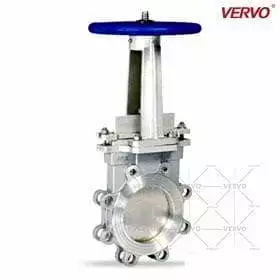
A knife gate valve is a specialized industrial shut-off valve engineered for demanding applications involving fluids with suspended solids, slurry, sludge, viscous liquids, and abrasive media. Unlike conventional gate or ball valves, the knife gate valve features a thin, sharp-edged gate plate designed to cut through thick or solid-laden fluids, ensuring reliable isolation and uninterrupted system performance. This makes it an essential solution for industries where clogging, erosion, and frequent maintenance are major operational challenges.
At its core, the knife gate valve is built for simplicity, durability, and efficiency. The gate moves vertically inside the valve body, providing either full closure or full opening. When closed, the sharp blade-like gate slices through solids in the flow, creating a tight shut-off. When opened, it retracts completely from the flow path, allowing media to pass through with minimal resistance and extremely low pressure drop. This full-bore design ensures smooth operation even in highly contaminated or abrasive environments.
The working principle of a knife gate valve is based on a linear motion mechanism. The gate plate travels up and down between two valve seats. In the closed position, the gate descends into the flow stream, cutting through dense media and sealing the passage effectively. In the open position, the gate lifts completely above the flow line, allowing unrestricted movement of fluid and solids.
Operation can be performed manually using a handwheel, gear system, or lever. For automated systems, knife gate valves can be equipped with pneumatic, hydraulic, or electric actuators. These automation options enable precise control, remote operation, and improved safety in industrial processes. Due to its robust structure and simple design, the valve performs exceptionally well in harsh conditions involving high solids content, abrasive particles, and corrosive environments.
Proper installation is essential to ensure long-term performance, sealing reliability, and operational safety. The following step-by-step installation process ensures correct mounting and efficient valve operation.
Before installation, ensure the valve is in the fully closed position to simplify handling and alignment. Carefully position the valve between pipeline flanges, making sure it is centered and aligned accurately with the pipe axis. Proper alignment prevents stress on the valve body and ensures uniform sealing performance. For large-sized knife gate valves, lifting equipment such as cranes or hoists should be used to ensure safe handling and positioning.
Once the valve is correctly positioned, install suitable gaskets between the valve flanges and pipeline flanges. Ensure that the gasket surfaces are clean, undamaged, and compatible with the media and operating conditions. Align gasket holes precisely with flange bolt holes to ensure proper sealing. Depending on the gasket type, a sealant may be pre-applied or manually applied according to manufacturer recommendations.
Insert bolts through the flange and gasket assembly, using washers on both ends to distribute load evenly. Begin tightening the bolts in a criss-cross pattern to ensure uniform pressure distribution across the gasket surface. Initially tighten loosely, then gradually increase torque in multiple stages. Avoid over-tightening, as excessive force may damage the gasket, distort flanges, or affect sealing integrity. A torque wrench should be used to achieve the manufacturer’s recommended torque values based on valve size and pressure rating.
For automated knife gate valves, install the actuator according to the manufacturer’s guidelines. This typically involves mounting the actuator securely onto the valve stem and ensuring precise alignment. Electrical wiring, pneumatic tubing, or hydraulic lines must be connected properly to the control system. After installation, test the actuator to confirm smooth opening and closing operations without binding or delay.
After installation, perform a full operational test. Cycle the valve several times to confirm smooth movement and proper sealing performance. Check for any mechanical resistance or irregular motion. Gradually pressurize the pipeline system while monitoring for leakage at flange joints and valve sealing areas. If leakage is detected, depressurize the system immediately and adjust bolt tension or replace gaskets as necessary. Final testing should confirm stable operation under normal working pressure conditions.
Knife gate valves are widely used across industries that handle challenging fluids. In the pulp and paper industry, they control fiber-rich slurry without clogging. In wastewater treatment plants, they manage sewage sludge and effluents with solid content. In mining operations, they handle abrasive ore slurries and tailings. They are also extensively used in chemical processing, food production, cement manufacturing, and power generation systems where reliable shut-off and minimal maintenance are essential.
Knife gate valves offer multiple operational advantages. Their simple structure reduces maintenance requirements and downtime. The sharp gate design ensures efficient cutting through solids, preventing blockage and improving flow control. Their full-port design minimizes pressure loss, making them highly energy efficient. Additionally, they provide excellent sealing performance in both low and moderate pressure systems and can be customized for a wide range of industrial applications.
As a leading Knife Gate Valve manufacturer in China, VERVO specializes in designing and producing high-quality knife gate valves for global industrial markets. With advanced manufacturing technology, strict quality control systems, and a focus on durability and performance, VERVO delivers reliable valve solutions tailored to complex working conditions. Our products are engineered to meet international standards and ensure long service life, stable operation, and cost-effective performance across demanding industries worldwide.
VERVO continues to innovate in valve engineering, providing customized solutions that meet the evolving needs of modern industrial systems.