Rising Stem Ball Valve
A rising stem ball valve is an advanced flow control device that combines the tight shut-off performance of a ball valve with the linear, non-rubbing operating mechanism of a gate valve. During operation, the stem rises and lowers the ball without friction against the seat, which significantly reduces wear, minimizes torque requirements, and extends service life. This design ensures reliable zero-leakage sealing while maintaining smooth, stable operation even under high-pressure and high-temperature conditions. It is widely used in industries such as oil and gas, chemical processing, and power generation. As a leading rising stem ball valve manufacturer in China, VERVO provides durable and precision-engineered solutions for critical industrial applications.
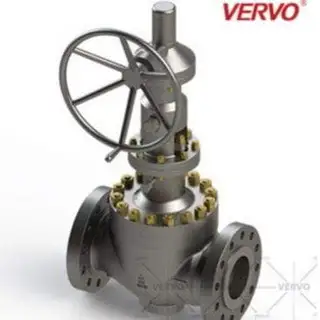
A rising stem ball valve is an advanced type of quarter-turn isolation valve designed to combine the reliable sealing performance of a traditional ball valve with the smooth, non-contact operating principle of a rising stem mechanism. Unlike conventional ball valves, where the ball directly rotates against the sealing seats, the rising stem design introduces a unique mechanical action: the stem first lifts the ball away from the seats before rotation occurs, and then lowers it back into position during closure. This dual-action movement—linear and rotational—significantly reduces friction, minimizes seat wear, and enhances long-term operational reliability in demanding industrial environments.
This innovative structure makes rising stem ball valves particularly suitable for applications that require frequent operation, tight shut-off performance, and extended service life under high pressure, high temperature, or corrosive media conditions.
A rising stem ball valve is composed of several precision-engineered components that work together to ensure safe and efficient flow control:
The ball is the core sealing element of the valve. It is a precision-machined spherical component with a central bore. When the valve is open, the bore aligns with the pipeline, allowing unrestricted fluid flow. When closing, the ball rotates 90 degrees to block the flow completely. The smooth surface finish of the ball ensures tight sealing and stable performance even under high differential pressure.
The stem is a critical mechanical linkage between the actuator or handle and the ball. In a rising stem design, the stem performs both vertical and rotational movement. As the valve operates, the stem lifts the ball away from the seat before rotation and lowers it back into sealing position afterward. This prevents rubbing between the ball and seat, significantly reducing wear and operating torque.
The seats are positioned on both sides of the ball and form the primary sealing interface. They are typically manufactured from high-performance materials such as PTFE, RPTFE, PEEK, or metal-seated alloys depending on application requirements. The seats ensure bubble-tight sealing and accommodate thermal expansion, pressure fluctuations, and chemical exposure.
The valve body provides structural integrity and houses all internal components. It is designed to withstand internal pressure and external mechanical stress while maintaining alignment of the ball and stem. Common body materials include carbon steel, stainless steel, and alloy steel, selected based on pressure class, temperature range, and corrosion resistance requirements. The body also connects the valve to the pipeline via flanged, threaded, or welded ends.
The operating principle of a rising stem ball valve is based on a coordinated lifting and rotating mechanism. When the valve is closed, the ball is firmly seated against the seats, and the bore is positioned perpendicular to the flow path, fully blocking fluid passage.
To open the valve, the stem first rises vertically, lifting the ball slightly away from the seat surfaces. Once the ball is fully disengaged, the stem continues its motion by rotating the ball 90 degrees so that the bore aligns with the pipeline. This two-step process ensures that the ball does not scrape against the seats during rotation, eliminating frictional wear.
During closing, the process is reversed. The stem rotates the ball away from the flow position, then lowers it back into the seats to achieve a tight, uniform seal. This controlled motion improves sealing consistency and significantly extends the service life of both ball and seat components.
Rising stem ball valves offer a range of performance benefits that make them highly suitable for critical industrial applications:
These valves provide reliable bubble-tight sealing when closed. The precise alignment of the ball and seats ensures zero leakage, making them ideal for handling hazardous, toxic, or high-value fluids where safety and containment are essential.
Because the ball is lifted away from the seats before rotation, there is minimal friction during operation. This non-rubbing mechanism greatly reduces wear on sealing surfaces, extending the operational lifespan of the valve and lowering maintenance frequency.
Rising stem ball valves maintain the quarter-turn operating principle, allowing rapid opening and closing. This is especially valuable in emergency shutdown systems and automated process control environments where response time is critical.
The separation of sealing and rotational functions reduces mechanical resistance, resulting in lower torque requirements. This makes the valve easier to operate manually and reduces the load on actuators in automated systems.
One of the most practical advantages of the rising stem design is its visible stroke movement. Operators can easily determine whether the valve is open, closed, or partially open simply by observing the stem position. This improves operational safety and reduces the risk of human error, particularly in complex pipeline systems.
Rising stem ball valves are highly versatile and can be used across numerous industries, including oil and gas transmission, chemical processing, petrochemical refining, power generation, water treatment, and industrial manufacturing. They are available in multiple sizes, pressure classes, and material configurations to meet diverse operational requirements.
The rising stem ball valve represents a high-performance evolution of traditional ball valve technology, offering enhanced sealing integrity, reduced mechanical wear, and improved operational visibility. Its unique lifting-and-rotating mechanism ensures smooth, reliable performance even under the most demanding service conditions. With excellent durability, low maintenance requirements, and broad industrial applicability, it has become a preferred choice for modern flow control systems where efficiency, safety, and long-term reliability are essential.