Parallel Slide Gate Valve
As a leading parallel slide gate valve manufacturer in China, VERVO delivers high-performance valve solutions designed for demanding industrial applications. Unlike conventional wedge-type gate valves, the parallel slide gate valve features two parallel discs and a freely moving stem, ensuring smooth operation and reduced mechanical stress. This advanced design minimizes the risk of jamming, thermal binding, and seat damage, providing long-term reliability in critical systems. It is especially suitable for high-pressure and high-temperature environments such as power plants, oil and gas pipelines, and petrochemical facilities. With excellent sealing performance and stable flow control, VERVO parallel slide gate valves ensure safe, efficient, and durable operation across a wide range of industries.
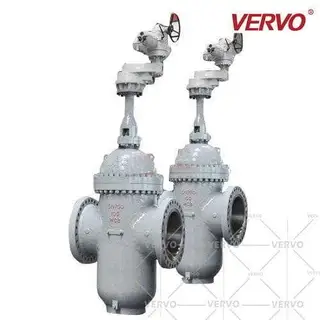
A parallel slide gate valve is a specialized type of sliding shut-off valve designed for efficient on/off flow control in high-pressure and high-temperature pipeline systems. Unlike conventional wedge gate valves that rely on a single wedge-shaped disc, the parallel slide gate valve uses two parallel discs that move vertically between the seat surfaces. This unique design ensures stable sealing performance, reduced mechanical stress, and improved resistance to thermal expansion issues.
The valve is widely used in industries where reliable isolation of media is critical, including power generation, oil and gas transmission, petrochemical processing, refining systems, and heavy industrial plants. Its ability to handle demanding operating conditions while maintaining tight shutoff makes it a preferred choice for engineers seeking long-term operational reliability.
A parallel slide gate valve is a linear-motion valve that controls fluid flow by raising or lowering a flat, parallel gate assembly. The closure element consists of two precisely machined, flat discs with highly polished sealing surfaces. These surfaces align tightly with the seat rings inside the valve body to create a secure seal when the valve is closed.
The main purpose of this valve is to completely stop or allow fluid flow within a pipeline. When open, the bore of the gate aligns perfectly with the pipeline diameter, allowing media to pass through with minimal obstruction. When closed, the gate slides down to block the flow path, isolating upstream and downstream sections effectively.
Unlike other gate valve designs, the parallel slide structure reduces jamming risks caused by thermal expansion or pressure-induced deformation. This makes it particularly suitable for steam, high-temperature fluids, and high-pressure applications.
The working principle of a parallel slide gate valve is based on vertical linear motion controlled by a stem mechanism. The valve operates through either manual or automated actuation.
When the operator rotates the handwheel or when an actuator is engaged, the stem begins to move the gate assembly vertically. The gate contains a full-bore opening that matches the internal diameter of the pipeline.
During opening, the gate is lifted upward by the stem. As it rises, the bore inside the gate aligns with the pipeline flow channel. This alignment creates a straight-through flow path with minimal turbulence and pressure drop. At full open position, the fluid flows freely through the valve without obstruction.
During closing, the gate moves downward into the seat area. Once fully lowered, the solid portion of the gate blocks the flow passage. The parallel sealing surfaces of the gate press against the seat rings, forming a tight shutoff.
A key feature of this design is that sealing force is often assisted by system pressure. In many configurations, upstream pressure helps push the gate more firmly against the seat, improving sealing efficiency and reducing leakage risk.
Because of the dual-disc structure, even slight wear or deformation is compensated by the internal spring mechanism, maintaining consistent sealing contact over long service periods.
A parallel slide gate valve is composed of multiple precision-engineered components that work together to ensure reliable performance, smooth operation, and long service life.
The valve body forms the main pressure-containing structure. It houses all internal components and provides the flow passage for the medium. It is typically manufactured from high-strength materials such as carbon steel, stainless steel, or alloy steel to withstand high pressure, corrosion, and extreme temperatures.
The body is designed with smooth internal flow geometry to reduce turbulence and minimize energy loss when the valve is open.
The gate is the core functional component of the valve. Unlike wedge gate valves, this design uses two parallel discs instead of a single wedge. These discs are precision-machined with flat, highly polished sealing surfaces.
A spring element is often installed between the two discs. This spring ensures constant contact with the seat rings, compensating for wear, thermal expansion, and minor misalignments.
The dual-disc structure also helps distribute pressure evenly, improving sealing reliability and reducing mechanical stress.
Seat rings are located inside the valve body and provide the sealing surface for the gate. When the valve is closed, the gate presses against these rings to prevent fluid leakage.
These seat rings are typically made from hardened stainless steel or other wear-resistant alloys. In many designs, they are replaceable, allowing for easier maintenance and extended valve service life.
Precision machining of seat surfaces is critical to achieving tight shutoff performance.
The stem connects the external actuator or handwheel to the internal gate assembly. It transmits rotational motion into vertical linear movement, enabling the opening and closing of the valve.
The stem is usually manufactured from corrosion-resistant stainless steel and is precisely threaded to ensure smooth and reliable operation under high loads.
Proper stem alignment is essential to prevent bending stress and ensure consistent performance.
The spring assembly is a distinctive feature of the parallel slide gate valve. It is positioned between the two parallel discs of the gate.
Its primary function is to maintain continuous sealing force between the gate and seat surfaces. Even when wear occurs over time, the spring ensures that both discs remain in proper contact with the seat, preserving sealing integrity.
This self-adjusting feature significantly enhances valve longevity and reliability in demanding operating conditions.
The bonnet is the top closure component of the valve body. It encloses the stem and provides a sealed housing for internal components.
It also allows access for maintenance, inspection, and replacement of internal parts such as the stem packing and gate assembly. In high-pressure applications, the bonnet is designed with reinforced construction and secure bolting to ensure safe operation.
Parallel slide gate valves offer several operational and engineering advantages that make them suitable for critical industrial systems:
- Excellent sealing performance under high pressure
- Reduced risk of jamming compared to wedge gate valves
- Stable operation in high-temperature environments
- Low wear due to parallel sealing surfaces
- Self-adjusting sealing mechanism via internal spring
- Minimal pressure drop when fully open
- Suitable for both steam and liquid media
- Long service life with reduced maintenance requirements
These advantages make them a reliable solution for continuous-duty industrial operations.
Parallel slide gate valves are widely used across industries that require reliable shutoff and high-performance sealing.
In thermal and nuclear power plants, these valves are used in steam systems, boiler feed lines, and turbine auxiliary systems due to their ability to withstand high temperature and pressure.
They are commonly installed in pipelines, refinery units, and processing facilities where secure isolation of hydrocarbons is required.
The valve is used in chemical processing lines handling aggressive fluids, solvents, and high-temperature media.
Refinery operations rely on these valves for process control, isolation, and safety shutoff in critical pipeline systems.
They are also used in steel plants, pulp and paper mills, and other heavy-duty manufacturing environments.
The parallel slide gate valve is a highly reliable and efficient solution for industrial flow isolation applications. Its dual-disc structure, spring-assisted sealing system, and robust construction allow it to perform effectively in high-pressure and high-temperature environments where traditional valve designs may struggle.
With excellent sealing performance, reduced maintenance needs, and long operational life, it has become a preferred choice in power generation, oil and gas, petrochemical, and other demanding industries. As industrial systems continue to evolve toward higher efficiency and safety standards, the parallel slide gate valve remains a critical component in modern fluid control engineering.