Fully Welded Ball Valve
A fully welded ball valve is designed with a one-piece welded body structure, where all key components—including the valve body, ball, and stem—are permanently sealed through high-strength welding. This construction eliminates flange connections and potential leakage points, delivering superior strength, durability, and long-term sealing reliability compared to split or bolted valves. It is especially suitable for underground pipelines, buried gas systems, and long-distance transmission lines where maintenance access is limited. With excellent corrosion resistance and leak-proof performance, fully welded ball valves ensure safe and stable operation. As a leading fully welded ball valve manufacturer in China, VERVO provides high-quality, reliable flow control solutions.
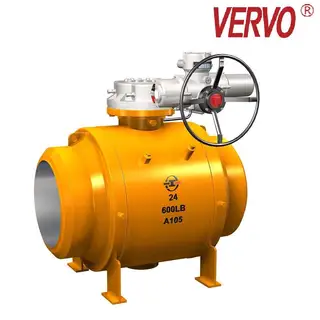
A fully welded ball valve is a high-strength industrial valve designed with a one-piece welded body structure, where all major components—including the valve body, ball, and stem—are permanently joined through precision welding processes. Unlike traditional bolted or split-body valves, a fully welded valve eliminates flange connections and body joints, significantly improving structural integrity and sealing performance.
This type of valve is widely used in natural gas transmission, oil pipelines, district heating systems, petrochemical plants, and underground pipeline networks, where long-term reliability, safety, and zero-leakage performance are essential. The most common configuration is the fully welded ball valve, which is specifically engineered for high-pressure and long-distance pipeline applications.
A fully welded valve is constructed from forged steel components that are permanently welded together to form a single, integrated valve body. The internal components—such as the ball, stem, and seats—are enclosed within this sealed structure.
The welded body design provides several key advantages:
- Eliminates flange joints and gasket connections
- Reduces potential leakage points
- Enhances mechanical strength and pressure resistance
- Improves resistance to external environmental stress
The result is a compact, durable valve designed for demanding applications where maintenance access is limited or not practical.
The most widely used type is the fully welded ball valve, which combines the benefits of a spherical flow control element with the robustness of a welded body structure.
The structure of a fully welded ball valve is engineered for maximum strength and reliability. Key components include:
- Forged Steel Body: Provides high structural strength and resistance to internal pressure
- Ball Element: Precision-machined for smooth rotation and reliable sealing
- Valve Stem: Transfers torque from actuator to ball with anti-blowout design
- Seats and Sealing Rings: Ensure bubble-tight shutoff under varying pressure conditions
- Welded Body Construction: Permanently seals all joints, eliminating leakage paths
Because the body is fully welded, the internal components are securely enclosed, making the valve especially suitable for underground or buried installations where disassembly is difficult.
The operating principle of a fully welded ball valve is based on a simple quarter-turn mechanism:
In the open position, the ball's bore aligns with the pipeline, allowing fluid or gas to flow freely with minimal resistance.
When the valve is rotated 90 degrees via the actuator or handle, the solid part of the ball blocks the flow path completely.
The seats press against the ball surface to create a tight, leak-proof seal.
The welded body ensures that all pressure is contained within the valve structure without external leakage points.
This simple yet highly effective mechanism provides fast operation, reliable shutoff, and stable performance in high-pressure environments.
Fully welded ball valves offer a wide range of operational and economic benefits, making them a preferred choice for critical pipeline systems.
One of the most important advantages of fully welded ball valves is their exceptional sealing performance. Since the valve body is constructed without flanges, bolts, or gaskets, there are no external joints that could become potential leakage points.
The welded structure creates a hermetic seal, ensuring complete isolation of the internal medium. This is especially important in applications involving:
- Natural gas transmission
- Petroleum pipelines
- Hazardous or toxic media
- Underground utility systems
The elimination of leakage risk significantly improves system safety and environmental protection.
Fully welded ball valves are designed for long-term, maintenance-free operation. With fewer mechanical connections and wear-prone components, the risk of failure is greatly reduced.
In many cases, these valves can operate reliably for 20 to 30 years or more, depending on operating conditions. This long service life makes them ideal for buried or remote pipeline systems where maintenance access is difficult or costly.
The robust welded structure also reduces fatigue caused by vibration, pressure fluctuations, and thermal expansion.
To enhance durability in harsh environments, fully welded ball valves are often treated with advanced protective measures such as:
- Anti-corrosive coatings
- Heat-treated forged steel materials
- High-grade stainless or alloy steel construction
- Specialized welding processes for environmental resistance
These features allow the valve to perform reliably in corrosive soil conditions, offshore environments, chemical exposure zones, and underground installations.
As a result, fully welded ball valves are widely used in pipelines that require long-term exposure to challenging environmental conditions.
Compared to traditional flanged or split-body valves, fully welded ball valves offer a more compact and streamlined structure. The elimination of bolts, flanges, and additional sealing components reduces both weight and overall size.
This compact design provides several advantages:
- Easier transportation and installation
- Reduced space requirements in pipeline systems
- Improved suitability for underground installation
- Lower structural load on supporting pipeline infrastructure
The lightweight structure also simplifies handling during construction and installation processes.
Although fully welded ball valves may require a higher initial investment, they offer significant cost savings over time. Their maintenance-free design and long service life greatly reduce operational expenses.
Key cost-saving factors include:
- No need for frequent maintenance or gasket replacement
- Reduced risk of leakage-related repairs
- Lower installation and support structure costs
- Minimal downtime in pipeline operation
Over the full lifecycle of the pipeline system, these advantages result in a much lower total cost of ownership compared to conventional valve designs.
Fully welded ball valves are widely used in industries where safety, reliability, and long-distance transmission are essential. Common applications include:
- Natural gas transmission pipelines
- Oil transportation systems
- District heating networks
- Petrochemical processing facilities
- Underground utility pipelines
- Offshore and subsea installations
Their ability to operate reliably under high pressure and extreme environmental conditions makes them a critical component in modern energy infrastructure.
A fully welded ball valve is a highly reliable and durable flow control solution designed for demanding industrial pipeline systems. Its welded body construction eliminates leakage points, enhances structural strength, and ensures long-term performance with minimal maintenance requirements.
With advantages such as superior leak tightness, extended service life, corrosion resistance, compact design, and low lifecycle costs, fully welded ball valves are especially suitable for underground and long-distance transmission applications. As a result, they have become an essential choice in the oil, gas, and energy industries, where safety and reliability are of the highest priority.