Dual Plate Check Valve Advantages, Working Principles, and Maintenance Tips
In modern fluid transportation and process control industries, maintaining safe, stable, and efficient flow direction is a critical requirement. One of the most widely used components for preventing reverse flow is the dual plate check valve. This valve type, also commonly referred to as a double door check valve or wafer check valve, has become an essential solution in industrial pipeline systems due to its compact design, fast response characteristics, and reliable sealing performance.
Dual plate check valves are engineered to automatically prevent backflow in pipelines carrying liquids, gases, steam, and condensate. They are widely applied in HVAC/R systems, municipal water supply networks, oil and natural gas pipelines, power generation systems, seawater desalination plants, chemical processing facilities, and metallurgical industries. With increasing demand for energy efficiency, safety, and reduced maintenance costs, this valve type has become a preferred alternative to traditional swing check valves in many engineering applications.
As industrial systems become more complex and pressure requirements increase, the need for reliable non-return flow control devices continues to grow. The dual plate check valve offers a balance of compact structure, fast closing action, and excellent hydraulic performance, making it a critical component in modern pipeline engineering.
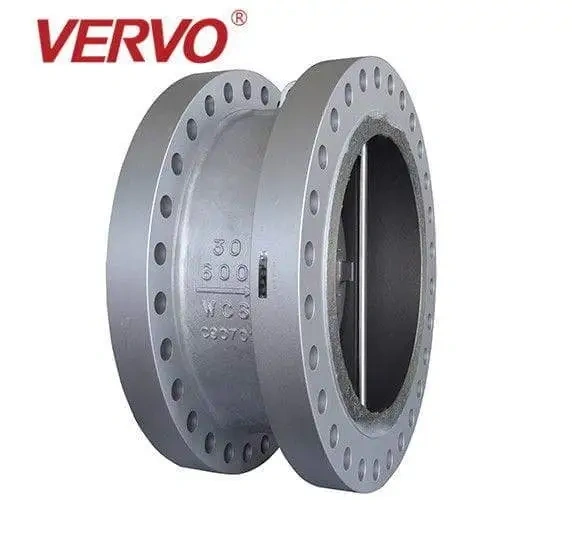
The dual plate check valve is designed with a compact and efficient internal structure that enables fast response and minimal pressure loss. The core structure consists of two semi-circular or semi-elliptical plates mounted on a central hinge pin or shaft. These two plates function together like a butterfly wing system, opening and closing in response to fluid flow direction.
When fluid flows in the forward direction, the pressure pushes the plates open. The plates rotate around the shaft and allow unobstructed passage of the medium. When the flow stops or reverses, the spring-assisted mechanism rapidly returns the plates to the closed position, sealing the pipeline and preventing reverse flow.
This structure is significantly more compact than traditional swing check valves. The dual plate design reduces the disc travel distance, resulting in faster closure and reduced water hammer effect. The wafer-style body design also allows the valve to be installed between flanges, minimizing installation space and weight.
Key structural components include:
- Valve body (wafer or lug type)
- Dual disc plates
- Spring mechanism (often stainless steel)
- Central hinge pin or shaft
- Seat sealing system
- Retaining ring or support structure
The simplicity of the design contributes to its durability and ease of maintenance, while still ensuring high performance under demanding industrial conditions.
The working principle of a dual plate check valve is based on differential pressure and spring-assisted closure.
When the upstream pressure exceeds the downstream pressure, fluid begins to flow through the pipeline. This pressure forces the two plates to open simultaneously. The plates rotate away from the flow path, allowing the medium to pass with minimal resistance.
During this stage, the valve creates a relatively low pressure drop compared to many traditional check valve designs. This contributes to improved energy efficiency in pumping systems.
When the flow slows or reverses, the system pressure decreases. At this moment, the spring mechanism, combined with back pressure from the fluid, forces the plates to close rapidly.
The closing action is fast and controlled, reducing the risk of sudden slamming. This is particularly important in preventing water hammer, a pressure surge phenomenon that can damage pipelines, pumps, and connected equipment.
Once closed, the plates form a tight seal against the valve seat. This prevents backflow and ensures system stability. The dual sealing surfaces provide redundancy, improving reliability even under fluctuating pressure conditions.
Dual plate check valves offer several technical advantages that make them suitable for a wide range of industrial applications:
The wafer-style design significantly reduces installation space requirements. This makes it ideal for systems with limited room between flanges.
Compared with swing check valves, dual plate models are much lighter, reducing support structure requirements and installation costs.
The spring-assisted mechanism ensures rapid closure, minimizing reverse flow and reducing water hammer effects.
The streamlined flow path allows fluid to pass with minimal resistance, improving system efficiency.
Double-disc sealing surfaces provide improved leak prevention, ensuring reliable backflow control.
These valves can handle water, oil, gas, steam, seawater, and various chemical media depending on material selection.
The simple internal structure allows for straightforward inspection, cleaning, and replacement of components.
The adoption of dual plate check valves across industries is driven by their multiple operational advantages.
Due to their low pressure loss design, these valves help maintain flow efficiency, reducing energy consumption in pumping systems.
Fast closure reduces the impact of reverse flow shockwaves, protecting pipelines and equipment from mechanical damage.
Lower weight and compact size reduce material usage, transportation costs, and installation labor expenses.
High-quality materials such as stainless steel, carbon steel, and alloy steels improve corrosion resistance and durability.
The wafer design allows easy installation between standard flanges without requiring additional structural modifications.
Dual plate check valves are manufactured using a variety of materials depending on application requirements:
- Carbon Steel (WCB): Suitable for general industrial water and oil applications
- Stainless Steel (CF8, CF8M): Ideal for corrosive environments and seawater systems
- Alloy Steel: Used in high-temperature and high-pressure environments
- Duplex Stainless Steel: Provides excellent resistance to chloride corrosion
- Bronze or Special Alloys: Used in marine and chemical applications
Manufacturing typically follows international standards such as API 594, API 6D, and ASME B16.34 to ensure reliability and performance consistency.
In modern engineering systems, dual plate check valves are often preferred over swing check valves due to their superior performance characteristics.
Feature | Dual Plate Check Valve | Swing Check Valve |
Size | Compact | Large |
Weight | Lightweight | Heavy |
Response Time | Fast | Slower |
Pressure Drop | Low | Higher |
Water Hammer Risk | Low | Higher |
Installation Space | Minimal | Requires more space |
This comparison highlights why dual plate designs are increasingly replacing traditional valve types in modern infrastructure projects.
Dual plate check valves are widely used across multiple industries:
They prevent reverse contamination and ensure stable water distribution in city pipelines.
Used to protect upstream equipment from backflow and maintain directional flow in crude oil and gas transportation systems.
Essential for maintaining refrigerant and chilled water flow direction in heating and cooling systems.
Used in boiler feedwater systems, steam lines, and condensate return pipelines.
Corrosion-resistant versions are used to handle high-salinity seawater environments.
Suitable for aggressive chemical media with proper material selection.
Used in slurry and process water pipelines under demanding conditions.
Proper installation is critical for optimal performance:
- Ensure correct flow direction alignment with valve body markings
- Install between properly aligned flanges to avoid stress
- Avoid installing directly after pumps without sufficient straight pipe length
- Ensure gasket compatibility for sealing reliability
- Support heavy pipelines to prevent mechanical stress on the valve body
Correct installation reduces operational issues and extends service life significantly.
Although dual plate check valves require minimal maintenance, periodic inspection is recommended:
- Check for disc wear and sealing surface damage
- Inspect spring mechanism for fatigue or corrosion
- Clean internal components if fouling occurs
- Verify smooth opening and closing movement
- Replace worn seals to maintain leak-free operation
Routine maintenance ensures long-term reliability in critical systems.
Caused by worn sealing surfaces or debris accumulation. Cleaning or seal replacement is recommended.
May result from weakened springs or buildup inside the valve.
Often due to improper installation or excessive flow turbulence.
Occurs in abrasive media applications; upgrading material selection can resolve this issue.
The future of dual plate check valves is closely linked to industrial automation and advanced materials engineering.
Key trends include:
- Increased use of corrosion-resistant composite materials
- Integration with smart monitoring systems
- Improved hydraulic modeling for reduced energy loss
- Enhanced sealing technologies for zero-leakage performance
- Greater adoption in renewable energy systems
As industries move toward higher efficiency and sustainability, valve technology will continue evolving to meet stricter performance and environmental requirements.
The dual plate check valve has established itself as a vital component in modern fluid control systems. Its compact structure, rapid response, low pressure drop, and reliable sealing performance make it a superior choice compared to many traditional check valve designs.
From municipal water systems to complex oil and gas pipelines, its versatility and efficiency ensure safe and stable operation across a wide range of industries. As engineering standards continue to advance, dual plate check valves will remain a key technology supporting global infrastructure, energy systems, and industrial automation.
With ongoing innovation in materials, design, and manufacturing precision, the dual plate check valve is expected to play an even greater role in the future of industrial flow control technology.