LNG Cryogenic Top-Entry Trunnion Ball Valves: Seat Sealing Design and Performance Study
Dec 11, 2025
With the rapid expansion of the LNG clean energy industry, the demand for cryogenic ball valves in LNG applications continues to increase, placing greater demands on their safety and sealing performance. However, domestic experience and experimental data on LNG cryogenic ball valves—especially regarding seat sealing—remain relatively limited. Therefore, this paper conducts a systematic study on the seat sealing of top-entry cryogenic trunnion-mounted ball valves and establishes a comprehensive technical roadmap covering material selection, structural design, and experimental verification. First, the physical properties of LNG, its preparation, storage, and transportation processes, as well as the valve application scenarios in LNG facilities, are analyzed to provide a foundation for material selection and structural design. Then, the key design requirements of cryogenic fixed ball valves under LNG service conditions are summarized from three perspectives: applicable design standards, material characteristics, and structural adaptability. Based on these requirements, this study examines metallic and non-metallic seat-sealing materials, sealing surface configurations, and the key factors influencing their sealing performance. A series of experiments is conducted to evaluate the cryogenic performance of PCTFE, the spring force and deformation behavior of Lipseal lip seals with different structures, and the changes in ferrite content in austenitic stainless-steel welds before and after cryogenic treatment. Based on the experimental results, optimized pressure-balance and online-maintenance structures are proposed to address engineering challenges such as insufficient seat-sealing reliability and the difficulty of achieving bidirectional sealing. Finally, using a top-mounted fixed ball valve prototype as the development platform, the valve was designed, manufactured, and tested, and the results verified both its sealing performance and the feasibility of the online-maintenance scheme. This work accomplishes the optimization and practical implementation of an LNG cryogenic top-mounted fixed ball valve design, providing valuable technical support for advancing the domestic development of cryogenic ball valves for LNG applications.
The global energy landscape has evolved alongside the Industrial Revolution. In the 19th century, coal was extensively developed as the main energy source for coal-fired steam engines. In the 20th century, the rise of oil, coupled with the rapid and widespread adoption of internal combustion engines, propelled petroleum to replace coal as the world’s primary energy source. As economies expand and populations grow, global energy demand continues to rise, increasing the need for cleaner and more efficient energy sources. During the development of the petroleum industry, the discovery and utilization of natural gas represented a significant breakthrough in this transition, and its expansion has continued to accelerate to meet growing societal demands. Natural gas liquefaction (LNG), a key process in the natural gas value chain, has gained increasing attention due to its clean, efficient, and easily transportable properties. Many countries have identified LNG as a preferred fuel, with the share of natural gas in their energy mix rising rapidly. LNG is growing at an annual rate of around 12%, making it one of the fastest-expanding energy sectors globally. To diversify their energy supply and improve consumption structures, major energy-consuming countries are increasingly focusing on LNG imports. Japan, South Korea, the United States, and Europe are building large-scale LNG receiving terminals, while international oil majors are increasingly focusing on LNG, positioning it as the next globally sought-after energy commodity after oil. As China’s economy continues its rapid expansion, the country faces severe shortages of the energy resources required to sustain this growth. Its energy structure remains heavily coal-dependent, with oil and natural gas comprising only a small fraction—far below the global average. As energy demand rises, the introduction and expansion of LNG will help optimize China’s energy structure, effectively addressing the dual challenges of energy security and environmental protection, and play a vital role in promoting sustainable economic and social development. The rapid growth of the LNG industry also increases demands on the equipment used across its production, storage, and transportation processes. Although cryogenic valves account for only a small fraction of LNG equipment, they are essential and play a critical role in system reliability and safety.
Liquefied natural gas (LNG) is natural gas in its liquid form. According to GB/T 19204, LNG is defined as a colorless liquid composed mainly of methane, with trace amounts of ethane, propane, nitrogen, and other components typically present in natural gas. Natural gas extracted from gas fields undergoes filtration, separation, drying, and liquefaction to produce LNG. The resulting LNG is colorless, odorless, non-toxic, and non-corrosive. LNG occupies roughly 1/600 of the volume of the same mass of natural gas, and its density is approximately 45% that of water. Both its density and boiling point depend on its composition. Its density typically ranges from 430 to 470 kg/m³, though it can reach up to 520 kg/m³ depending on composition. At atmospheric pressure, its boiling point generally falls between –166 °C and –157 °C. LNG is flammable and explosive, and its extremely low temperature can pose serious risks of cryogenic burns or material embrittlement. Table 1.1 summarizes the representative physical properties of LNG.
Properties at Bubble Point Under Atmospheric Pressure
Property | Example 1 | Example 2 | Example 3 |
Molar Fraction (%) |
|
|
|
N₂ | 0.5 | 1.79 | 0.36 |
CH₄ | 97.5 | 93.90 | 87.20 |
C₂H₆ | 1.8 | 3.26 | 8.61 |
C₃H₈ | 0.2 | 0.69 | 2.74 |
i-C₄H₁₀ | — | 0.12 | 0.42 |
n-C₄H₁₀ | — | 0.15 | 0.65 |
C₅H₁₂ | — | 0.09 | 0.02 |
Relative Molecular Mass (kg/kmol) | 16.41 | 17.07 | 18.52 |
Bubble Point Temperature (°C) | –162.6 | –165.3 | –161.3 |
Density (kg/m³) | 431.6 | 448.8 | 468.7 |
Gas Volume Generated at 0 °C, 101 325 Pa |
|
|
|
per unit liquid volume (m³/m³) | 590 | 590 | 568 |
per unit liquid mass (m³/10³ kg) | 1367 | 1314 | 1211 |
After extraction from gas fields, natural gas undergoes pretreatment, liquefaction, and other processing steps to produce LNG, which is then transported through pipelines to storage tanks. From there, it is transported to LNG receiving terminals for storage. After regasification, the LNG enters the natural gas distribution network.
Pretreatment:
Natural Gas Extraction → Filtration → Separation → Drying → Filtration
Liquefaction:
Heavy Hydrocarbon Separation → Multi-stage Cryogenic Cooling (Low, Medium, High Pressure) → Cold Box → LNG Tank
Transportation:
LNG Tank → LNG Carrier → Receiving Terminal
Regasification:
LNG Tank → Metering → THT Odorization → Gasification → Natural Gas Pipeline
In the LNG preparation, storage, and transportation process, cryogenic valves perform the same functions as conventional valves, serving to connect or isolate pipeline media and to regulate pressure and flow. Currently, cryogenic valves include gate, globe, check, ball, butterfly, and throttle valves, and are primarily used in equipment for gas liquefaction, separation, transportation, and storage. LNG valves must withstand media temperatures of –162 °C or lower, and to ensure reliable performance, they should be designed and tested for –196 °C conditions. Valves are often fitted with extended bonnets to keep the valve packing near room temperature, preventing icing that could damage the valve stem seal and lead to seal failure. Both the valve’s metal components and sealing materials must be suitable for –196 °C design temperatures and compatible with the flammable and explosive characteristics of LNG.
Compared with split-type valves, top-mounted (top-loading) designs offer several key advantages:
Integrated valve body: The valve body is a single, unified structure, with the body-cover seal and bolts positioned perpendicular to the pipeline axis. As a result, the body-cover seal remains unaffected by pipeline stress.
Online maintenance: LNG valves are generally welded at their connection ends, making disassembly challenging. Top-mounted designs enable convenient online maintenance.
Optimized stress distribution: The internal cavity of an integrated valve body can be shaped as a ball chamber, providing improved stress distribution.
Reduced leakage points: Compared to three-piece ball valves, top-mounted designs eliminate the middle flange seal, decreasing potential leakage points and reducing overall costs.
Therefore, under LNG operating conditions, top-mounted cryogenic valves offer distinct practical advantages and are highly suitable for industrial applications.
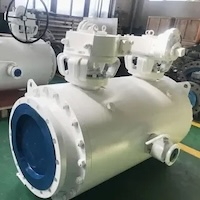
Cryogenic valves are essential control devices in low-temperature fluid pipeline systems. LNG cryogenic ball valves combine the inherent advantages of ball valves—such as simple structure, excellent sealing performance, low operating torque, easy operation, rapid actuation, low fluid resistance, and convenient maintenance—and are widely used in LNG carriers and receiving terminals. Under LNG operating conditions, ball valves must maintain internal leakage within allowable limits and ensure that external leakage complies with ISO 15848 Class B low-leakage standards. Valves meeting these standards typically use non-metallic seals. LNG cryogenic ball valves operate with a 90° rotation, which can be driven manually or automatically. Based on the ball mounting method and sealing principle, ball valves are classified as floating or fixed. Fixed ball valves have the ball anchored by a pivot or support plate, minimizing the impact of the large-diameter ball’s weight on sealing performance. These valves typically employ bidirectional sealing seats, with springs supplying an initial preload to maintain reliable sealing under low-pressure or no-pressure conditions. To ensure reliable bidirectional sealing and prevent dangerous pressure buildup in the valve cavity, the design complies with Double Block and Bleed (DBB) and self-relief requirements. The valve cover features an extended design to protect the stuffing box, whose sealing performance is crucial; at cryogenic temperatures, the packing’s elasticity decreases, compromising leak-tightness. Leakage at the packing can cause ice formation, hinder the valve stem’s operation, and may scratch the packing, resulting in significant leakage. The extended valve cover raises the stuffing box to maintain near-room temperature (19–10 °C) and includes a drip plate for thermal and moisture insulation, effectively preventing frost and ice formation. To facilitate online maintenance and minimize leakage points, the valve is designed with a top-mounted, integrated body. The design additionally provides fire resistance, anti-static protection, and valve stem blowout prevention. A simplified schematic of a typical LNG top-mounted cryogenic fixed ball valve is shown in Figure 1.2. External leakage is controlled through a double-seal arrangement at the body-cover joint, combining a Lipseal lip seal and a graphite spiral-wound gasket, achieving ≤50 ppmv helium leakage per ISO 15848, and a double-seal at the valve stem using a Lipseal and low-leakage molded graphite packing, meeting ISO 15848 Class B standards. Both internal and external leakage points comply with fire-resistance requirements according to AP1607. When fully closed, the valve seat is pressed against the ball by spring preload, providing low-pressure sealing. As inlet pressure rises, a pressure differential forms at the seat interface (based on the area-difference principle), increasing the sealing force and ensuring reliable bidirectional tightness. Although top-mounted LNG cryogenic fixed ball valves provide considerable advantages, the extreme cryogenic conditions impose strict operational and design requirements. For example, sealing surfaces that interface with Lipseal seals must achieve a roughness of ≤Ra0.4 for static sealing and ≤Ra0.2 for dynamic sealing, which is especially difficult to achieve on inner bore surfaces. Furthermore, the standardized dimensions and limited adaptability of Lipseal seals complicate the design of DIB-2 functional valve seats, and ensuring convenient online maintenance remains challenging. At present, most LNG ball valves used domestically are imported, leading to high costs. The increasing demand for high-standard, high-performance domestically produced valves makes the development and study of seat sealing in top-mounted LNG cryogenic fixed ball valves both urgent and critical, as this design represents the mainstream structure in LNG applications.
Figure 1.2 Schematic diagram of the structure of an LNG top-entry ultra-low temperature fixed ball valve
Previous: Optimization Design of a Wedge Gate Valve Plate Based on RSM
Next: Current Status and Challenges in Seat Sealing for LNG Top-Entry Cryogenic Trunnion Ball Valves