Replacing Imported Cryogenic Valve Parts with Domestically Produced Components
May 20, 2026
Abstract: Against the backdrop of the global energy transition and the "dual-carbon" strategy, the reliability of cryogenic valves in LNG terminals has drawn increasing attention. Long-term reliance on imported key components has led to numerous issues, including high costs, long delivery cycles, and maintenance constraints. This paper therefore concentrates on the key components of an imported cryogenic valve, including sealing rings, valve seats, and packing, and explores the manufacturing processes needed to produce these spare parts domestically. By integrating reverse engineering, material analysis, secondary design, process manufacturing, and on-site disassembly and assembly verification, a full technical chain from disassembly and analysis to mass production has been developed. The results demonstrate that domestically produced spare parts perform at -196 °C at levels meeting or even exceeding API 6D standard requirements, thereby establishing a scalable technical standard and enhancing both the operational stability and cost-effectiveness of LNG receiving terminals.
Against the backdrop of an accelerating global energy transition and the in-depth implementation of the "dual-carbon" strategy, the reliability of cryogenic valves has become a core requirement for ensuring the safe and stable operation of LNG receiving terminals, with zero leakage emerging as the industry's technical benchmark. During terminal operation, critical equipment such as cryogenic ball valves, butterfly valves, and control valves are subjected .year-round to multiple coupled effects, including cryogenic conditions, pressure cycling, alternating thermal shocks, and corrosive media. If core components of these devices—such as valve seats, sealing rings, packing, and bushings—fail, media leakage is highly likely. In severe cases, this can lead to pipeline shutdowns or even serious incidents such as process interruptions, posing a direct threat to energy supply security. However, the contradictions arising from long-term reliance on imported key components are becoming increasingly prominent. From a cost perspective, the unit price of imported components is approximately two to three times that of domestic alternatives. When tariffs, international freight, and insurance costs are added, the overall cost increases significantly. From a delivery cycle perspective, the international supply chain process is lengthy, with an average lead time of 8 to 16 weeks from order placement to customs clearance, making it difficult to meet urgent on-site requirements. In the event of a sudden failure, the lack of emergency inventory can result in losses of 3 to 5 million RMB from a single downtime event lasting just 3 to 5 days. Furthermore, on-site maintenance is constrained by the need for remote technical support from overseas manufacturers. The delayed response makes the maintenance cycle unpredictable, further exacerbating the risk of unplanned downtime.
Currently, the Qingdao LNG and Tianjin LNG Phase I projects have entered the maintenance phase, while the Huaying LNG, Beihai LNG, Longkou LNG, and Yanjiang LNG terminals are either under construction or in the planning stages. The market demand for cryogenic valves used in liquefied natural gas (LNG) is growing. Driven by industrial policies focused on "securing supply, reducing costs, and improving efficiency," as well as the push for self-reliance and control over energy equipment, the localization of cryogenic valve spare parts has gradually become part of joint research initiatives undertaken by energy companies and equipment manufacturers.In recent years, the National Energy Administration has coordinated partnerships between leading companies—including Hubei Taihe and Suzhou Neway—and CNPC and Sinopec, resulting in a localization rate exceeding 80% for cryogenic valves.However, key structural components—namely seals and packings—continue to be supplied exclusively by foreign manufacturers such as 3M, Garlock, and James Walker. Consequently, advancing research on the localization of spare parts for LNG cryogenic valves is of considerable importance.
This research aims to develop domestic alternatives for the core components of cryogenic valves. Taking typical imported valves as examples—such as Flowserve control valves, AMPO ball valves, ORTON butterfly valves, and Fisher control valves—the study employs disassembly mapping and material performance characterization to establish design benchmarks that comply with international standards. Based on this, domestic spare parts design schemes are developed to ensure performance compliance and structural interchangeability in cryogenic environments. Simultaneously, selection and processing technologies are optimized to establish applicable technical standards and enhance the performance of domestic spare parts. Furthermore, rapid disassembly and assembly tools are developed, assembly procedures and maintenance strategies are established, and a quality traceability mechanism is implemented. These efforts enhance the safety and efficiency of spare parts replacement, reduce dependence on external technical support, shorten maintenance cycles, and improve overall performance. To ensure the operational stability of LNG receiving terminals, the technology verification phase employs a combination of ambient and cryogenic testing to verify the performance of domestically produced spare parts under simulated actual operating conditions, thereby ensuring their reliability. Through full life-cycle cost analysis, the cost differences between imported and domestic spare parts are compared and improvements are made. This forms a standardized system covering the entire industry chain—from design to operation and maintenance—thereby enhancing China's competitiveness in the LNG engineering equipment field.
International cryogenic valve technology has a long history of development, having formed a comprehensive theoretical system and industrial ecosystem, and currently holds a leading position in the global market.Internationally renowned companies like 3M, Garlock, and James Walker have long dominated the global market by leveraging comprehensive standards, advanced material systems, and sophisticated manufacturing processes. In terms of standard frameworks, specifications such as API 6D, ASME B16.34, BS 6364, and MSS SP-134 not only provide a theoretical basis for the material selection of cryogenic valves but also establish quantifiable technical requirements for key aspects such as face-to-face dimensions, testing methods, and quality evaluation
In terms of material technology, leading European and American companies such as Emerson and Velan typically use cobalt-based and nickel-based cryogenic stable alloys as the substrate. These are supplemented by laser cladding or thermal spraying processes to deposit hard coatings like WC-Co and Ni-Cr, which significantly improve the wear resistance, heat resistance, and impact resistance of the sealing surfaces. Some companies use high-velocity oxygen fuel (HVOF) spraying to prepare WC-Co and Ni-Cr coatings, achieving microhardness levels of HV1300–100, which exhibit excellent wear and corrosion resistance. However, the fracture toughness and thermal shock stability of these coatings in a cryogenic environment of -196°C still require further verification. To further enhance the reliability of the sealing layer, elastic gaskets, O-rings, or lip seals are typically added between the metal sealing surfaces. This multi-layer sealing barrier effectively prevents media leakage. Flexible graphite can maintain a rebound rate of 5% to 10% at -200°C, with its stress relaxation rate controlled within 10%, making it one of the mainstream materials for non-metallic sealing components in cryogenic valves.
At the manufacturing process level, leading companies such as Flowserve, Velan, and WEKA have widely deployed five-axis CNC and in-process measurement systems, and are piloting digitally driven closed-loop machining modes on some production lines. For critical sealing surfaces, small-diameter, high-grade valves can achieve stable surface roughness control at Ra 0.4–0.8 μm, with dimensional tolerances compressed to within ±0.01 mm, significantly improving part interchangeability. Velan France, through its integrated welding center, combines preheating, automated welding, and post-weld heat treatment into a single production line. The entire temperature profile is managed by a CNC program, resulting in a first-pass yield rate for typical LNG valve body welds that exceeds the industry average.The Flowserve Valtek Valdisk high-performance butterfly valve, launched in 2020, is mass-produced to cover a wide temperature range from -196°C to 427°C. It can also be equipped on demand with multi-parameter sensors for position, temperature, and vibration, enabling remote condition monitoring and predictive maintenance.
Research and development of cryogenic valves in China started relatively late. However, with the rapid growth of the LNG industry, related research and industrialization efforts have accelerated significantly. Leading domestic enterprises such as Hubei Taihe, Suzhou Neway, and CNNC Suzhou Valve have established cryogenic testing facilities and micro-leakage detection platforms, enabling them to manufacture products in compliance with standards such as API 6D and ISO 15848-1.Hubei Taihe has taken the lead in commissioning 42" Class 150 cryogenic butterfly valves at the Zhoushan LNG receiving terminal, and these valves have successfully passed the localization certification. Furthermore, NPS6–10" Class 1500 cryogenic ball valves and NPS24–42" cryogenic butterfly valves from Jiangsu Shentong, Tianjin Xiangjia, and CNNC Technology have been put into use for the first time at multiple LNG receiving terminals in Jiangsu and Binhai.Following 2,000 cycles, the leakage rate is maintained below 10⁻⁴ Pa·m³/s, and critical performance metrics are approaching those of comparable imported valves. In conjunction with domestic manufacturers, the State Pipeline Group has taken the lead in commissioning 42" Class 150 triple-eccentric cryogenic butterfly valves at the Longkou LNG receiving terminal, thereby achieving full localization of the complete 8" through 46" series. Relative to imported counterparts of comparable specifications, the per-unit procurement cost has been reduced by approximately 60%, while the delivery lead time has been shortened from six months to ten to twelve weeks.The 16 42" butterfly valves installed in the first phase of the Longkou project have achieved investment savings exceeding 20 million yuan. Driven by CNOOC's 15-year sustained efforts toward the localization of cryogenic valve production, core equipment for LNG receiving terminals is gradually breaking free from import reliance.Concurrently, a digital closed-loop paradigm—exemplified by a national pipeline network-led initiative and encompassing the sequential stages of disassembly, 3D scanning/SEM composition analysis, CAD/CAE secondary design, five-axis precision cutting, and leak detection verification via -196°C liquid nitrogen and helium mass spectrometry—has been established and is presently being disseminated across the industry.
However, substantial challenges remain in high-end applications. At the material level, conventional fluororubber is limited to a service temperature range of -15°C to 20°C. Domestically produced cryogenic-grade modified fluoroether rubber exhibits a rebound rate approximately 10% inferior to that of imported Viton GLT at -50°C, and the -196°C operating condition necessitates the use of metal-graphite composite seals.With respect to manufacturing process consistency, although high-end five-axis machining centers—following thermal drift compensation—are capable of maintaining critical dimensional tolerances within 0.01 mm, tool wear and batch-to-batch variability can nonetheless induce dimensional fluctuations on the order of ±0.01 to 0.02 mm, thereby impairing the interchangeability of sealing pair components.With respect to evaluation systems, aside from demonstration initiatives such as those undertaken by the national pipeline network, the industry has yet to establish universally recognized lifespan verification standards that encompass 10,000 cycles with media containing impurities. Hence, the systematic replacement of imported components will continue to require time.
This investigation focuses on various types of imported cryogenic valves currently in service at Qingdao Liquefied Gas Company. A detailed enumeration of valve components is presented in Table 1. These valves primarily execute regulation, shut-off, and isolation functions within the LNG process chain, operating continuously in a cryogenic environment of approximately -192°C over extended durations. These valves experience frequent pressure fluctuations and thermal cycling, which necessitate repeated spare parts replacements, prolonged import procurement cycles, and elevated costs. Accordingly, the domestication of spare parts production constitutes a primary objective. This investigation focuses on the core components most vulnerable to wear and operational failure, including valve seats, sealing rings, valve stem packing, bushings, and guide rings.
Item No. | Valve Type and Size | Technical Requirements | Types of Domestically Produced Replacement Parts | Components | Unit Quantity |
1 | Control Valve, Class 900, 4 in. | Achieve domestic replacement of 5 spare parts | 5 types | Bushing, Packing, Valve Seat Gasket, Guide Ring, and Seat Gasket | 1 set |
2 | Cryogenic Ball Valve, Class 900, 10 in. | Achieve domestic replacement of 10 spare parts | 10 types | Packing, Valve Stem Lip Seal Ring, Valve Stem Gasket, Valve Body Gasket, Valve Seat, Valve Seat Snap Ring, Valve Seat Ring, Washer, Valve Seat Seal-1, and Valve Seat Seal-2 | 1 set |
3 | Cryogenic Gate Valve, Class 150, 8 in. | Achieve domestic replacement of 8 types of ORTON spare parts | 8 types | Replaceable Valve Seat Gasket, Bolt-Fixed Valve Seat, Sealing Gasket, Valve Bottom Flange Gasket, Sealing Ring, Extended Bonnet Gasket, Valve Top Inlet Flange Gasket, and Valve Stem Packing | 1 set |
4 | Control Valve, Class 900, 4 in. | Achieve domestic replacement of 7 types of FISHER valve seat spare parts | 7 types | Packing, Actuator Bushing, Actuator O-ring, Gasket, Valve High-Pressure Anti-Extrusion Ring, and Valve Core Sealing Ring | 1 set |
The overarching goal of this research is to establish a scalable technological system for the design and manufacture of domestically produced spare parts, thereby achieving independent replacement of critical components while preserving assembly interchangeability. The intended outcomes include cryogenic sealing performance, dimensional accuracy, and fatigue life that meet or surpass those of imported counterparts. Consequently, this research aims to shorten procurement cycles, reduce losses due to downtime, and improve both the safety and economic viability of LNG receiving station operations.
To accomplish this objective, a technical methodology comprising the sequential stages of "reverse engineering analysis → forward design → process solidification → verification closed loop" is proposed. In the initial phase, imported valve spare parts will be subjected to disassembly, dimensional mapping, and materials characterization to construct a high-precision geometric model and to elucidate the key design control parameters. Informed by benchmarking results of both domestic and foreign components, a locally engineered solution suitable for cryogenic service conditions will be devised. Material systems will be selected, and the sealing pair geometry as well as mating clearances will be optimized to assure sealing integrity and assembly interchangeability under extremely low-temperature operating environments. Subsequently, a comprehensive process chain encompassing blank manufacturing, heat treatment, surface strengthening, functional coating, and precision grinding will be established. Critical quality control nodes will be designated, and online inspection specifications will be determined to achieve stable surface quality and dimensional consistency in mass production. In the final phase, a performance verification protocol for both ambient and cryogenic temperature environments will be formulated, incorporating helium mass spectrometry leak detection, pressure testing, and cyclic life assessment. Furthermore, online maintenance tooling and replacement procedures will be developed based on actual operating conditions within the station. Prototype installation demonstrations will be undertaken, and operational data will be continuously acquired to validate the long-term reliability of the domestically engineered solution.
Reverse mapping technology is utilized to extract structural features and precise geometric parameters from imported spare parts, and quantitative analysis of their performance metrics is conducted to establish the design baseline for domestically manufactured counterparts. Drawing upon benchmarking results of both domestic and foreign spare part parameters, a secondary design scheme is formulated to optimize structural configurations and material pairings. Subsequently, a full-process manufacturing chain is constructed around the optimization scheme to assure consistency in machining accuracy and performance characteristics. Upon conclusion of trial production, sealing performance, structural strength, and cyclic life are evaluated under cryogenic conditions, and comprehensive data records are maintained. Subsequently, certified domestically manufactured spare parts are incorporated into the operational production line to assess their extended-cycle performance characteristics. The detailed procedure is as follows:
(1) Material analysis and screening: The valve body, valve seat, and lip seal of the imported cryogenic valve are disassembled, followed by coupled analysis utilizing energy dispersive spectroscopy and scanning electron microscopy (EDS‑SEM). In conjunction with cryogenic tensile and impact testing, the alloy element distribution (presented in Table 2), grain size, and toughness index under -196°C conditions are characterized to establish a compositional mapping to performance attributes. In accordance with standards such as ASTM A182 F316 and GB/T 12229, domestically sourced alternative materials that satisfy the requisite criteria are selected to ensure superior toughness, sealing integrity, and corrosion resistance at -196°C, while also conforming to the API 6D standard.
Table 2. Metal Composition of the FLOWSERVE Control Valve Seat Gasket
Element | Mass Fraction / % | Confidence Interval (±3σ) |
Fe | 69.520 | 0.990 |
Cr | 16.530 | 0.700 |
Ni | 10.410 | 0.760 |
Mo | 2.038 | 0.094 |
Mn | 1.490 | 0.480 |
Cu | Trace content | ≤ 0.064 |
(2)Structural mapping: Use a coordinate measuring machine and a blue light scanner to obtain geometric parameters such as the inclination angle of the sealing surface and the mating dimensions, and construct a complete geometric database. Establish a three-dimensional nonlinear contact finite element model and perform thermo-mechanical coupling analysis to evaluate the sealing performance of the valve seat and valve core. Based on this, conduct numerical simulations to investigate the sealing contact width, compression of the non-metallic sealing ring, and bolt preload.
(3) Secondary design optimization strategy: By introducing a continuously curved “G”-shaped transition surface, stress concentration in regions with abrupt geometric changes was significantly reduced. By adjusting the valve seat cone angle in 0.1° steps over a range of 0.5° to 1.0°, we reduced the non-uniformity of the sealing contact pressure distribution and simultaneously improved the springback compensation capability. Pre-compression of the sealing ring was implemented at two thickness levels, +0.10 mm and +0.20 mm, to further improve its springback performance at low temperatures.
(4)Process chain optimization: A comprehensive process flow framework was developed, encompassing parts disassembly, cleaning, precision machining, subcritical cryogenic treatment, surface strengthening, assembly, and inspection. Ultrasonic cleaning was carried out in a non-acidic medium to eliminate submicron-level contaminants. In the five-axis CNC machining stage, critical control parameters were defined for coating thickness, porosity, and the grinding process. Solution treatment (1050°C/30 min) of the 316L stainless steel substrate was followed by deep cryogenic treatment at -196°C in liquid nitrogen for 8 hours, achieving grain refinement and dimensional stability. HVOF WC-Co coating and precision grinding produce a hard sealing surface with Ra 0.2–0.4 µm; SPC (statistical process control) is applied across the entire process to ensure batch-to-batch consistency.
(5) Performance verification and operation/maintenance adaptation: For small-batch finished samples, testing was performed per GB/T 24925 and API 6D standards. This included helium mass spectrometry leak testing (with allowable leakage rates of 1×10⁻⁴ Pa·m³/s for soft-sealing valves and 1×10⁻³ Pa·m³/s for hard-sealing valves), a pressure withstand test at the rated pressure of 10 MPa, and a 5,000-cycle life test. The test results were then compared to the benchmark established by imported components (Figure 1). Any detected deviations triggered a review and readjustment of the design and process, forming an iterative closed loop and building a performance degradation database. To meet the requirement for rapid on-site replacement, a portable maintenance tool featuring integrated torque sensing and low-frequency vibration monitoring was developed. This reduced the replacement time for a single valve spare part from 3–5 days to 1–2 days. This delivers a closed-loop technology system encompassing the entire lifecycle, ranging from material verification to engineering operation and maintenance.
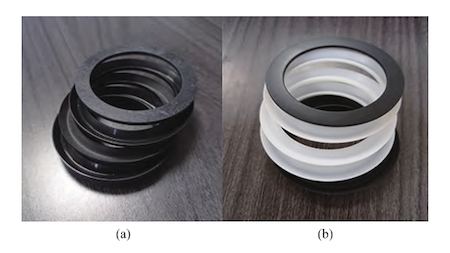
(a) Sample (b) Finished product
Figure 1 FLOWSERVE Control Valve Packing
Previous: Choosing The Right Cryogenic Butterfly Valve For Low-Temperature Pipelines
Next: What Is an Eccentric Plug Valve? Complete Guide for Industrial Flow Control